Nakata laboratory (BOC-lab)
Biomolecular Organization Chemistry Research Section
Biofunctional Chemistry for Bioenergy Research:
Toward the Creation of Energy Utilization Systems Inspired by Ingenious Biological Mechanisms
Toward the Creation of Energy Utilization Systems Inspired by Ingenious Biological Mechanisms
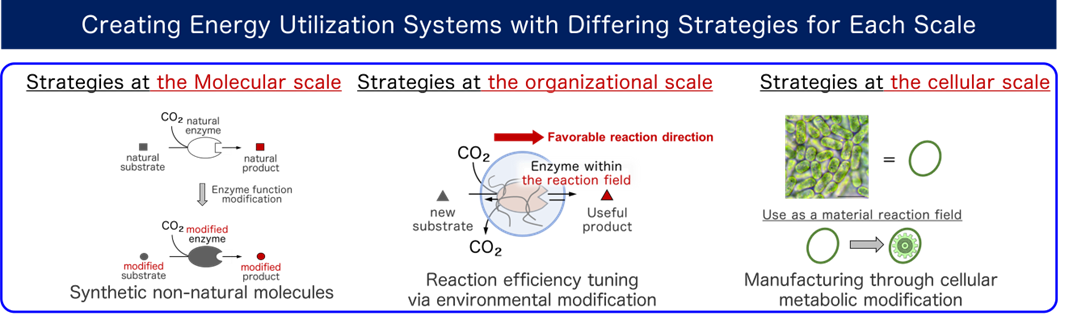
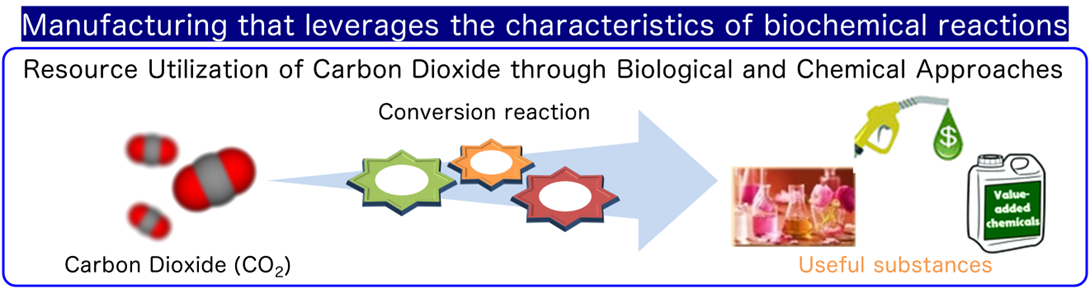
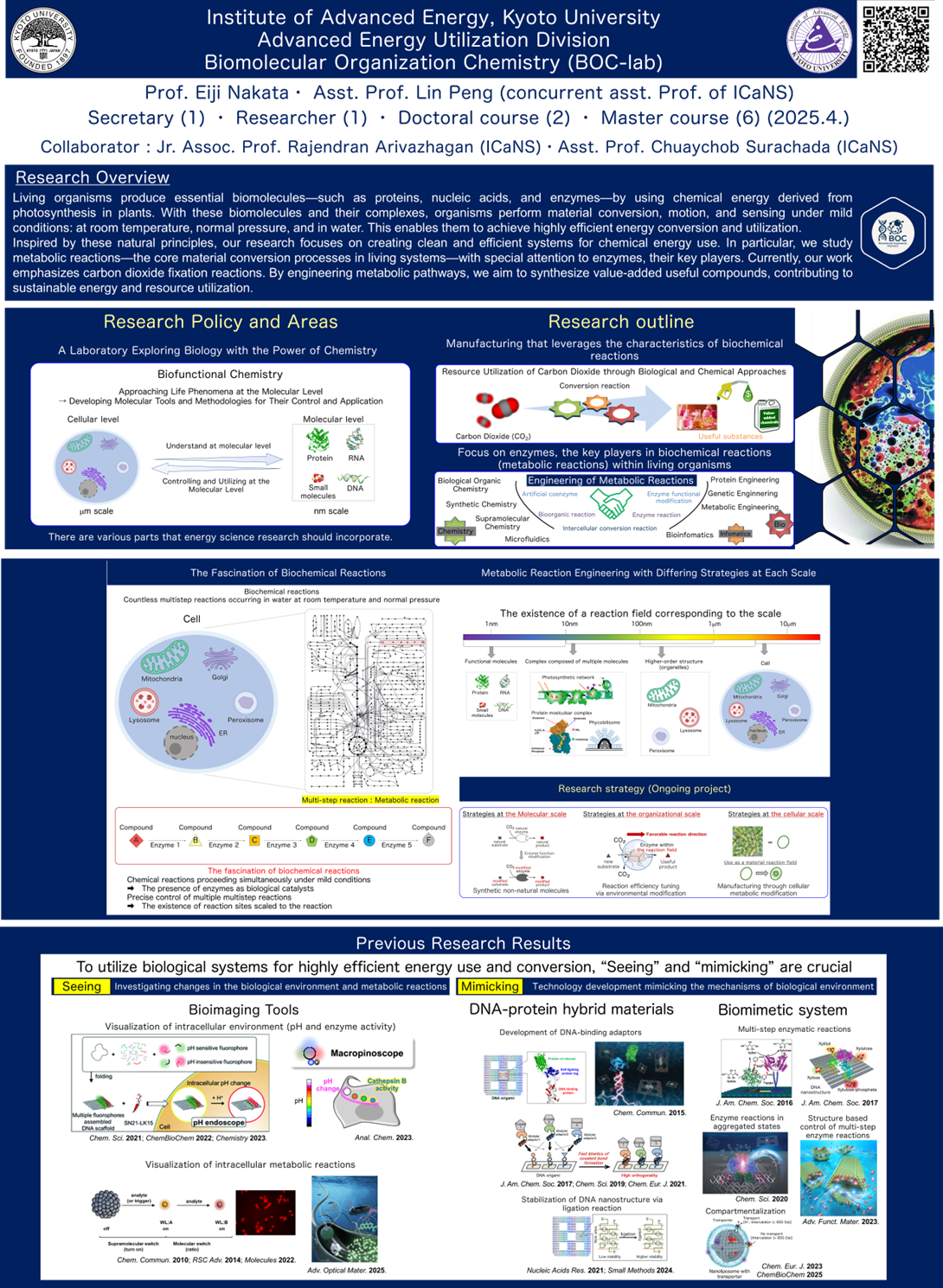
In our laboratory, we explore how living systems—especially enzymes—can inspire new ways of using energy. By organizing biomolecules for specific purposes, we aim to create innovative material conversion systems that actively use greenhouse gases, particularly carbon dioxide, as valuable resources. Through this biological approach, we strive to advance energy research that contributes to achieving a truly carbon-negative future.
×
![]()
Introduction to our research : click to enlarge
Introduction to our research : tap to enlarge
→ For more details...
〇The Appeal of Material Conversion Reactions Using Biological Systems
Living organisms achieve diverse material transformations under mild conditions of normal temperature and pressure by utilizing enzymes, which are biological catalysts. In contrast, industrial processes involve high-temperature, high-pressure conditions or metal catalysts, requiring substantial energy input and resource consumption. Thus, biological systems stand in stark contrast to industrial systems, offering the attractive feature of being “highly efficient with low energy costs”.Furthermore, industrial systems heavily depend on specific fuels (coal, oil, natural gas, etc.), raising concerns about resource depletion and environmental impact. In contrast, organisms directly utilize the inexhaustible energy source of sunlight through photosynthesis and flexibly recycle organic and inorganic materials as resources, achieving diverse and sustainable energy utilization. Moreover, biological metabolism incorporates mechanisms that recycle waste as resources for subsequent life activities, forming closed loops across the entire natural world. Industrial systems, however, frequently generate vast amounts of waste and byproducts, making their disposal a significant concern due to the associated costs and environmental burden.
Moreover, biological energy utilization stands out not merely as an industrial, linear system of “consuming fuel to generate output”, but also for its integration with information systems. Energy metabolism within organisms is dynamically adjusted in response to internal environmental changes, linked to sophisticated control mechanisms governing growth, differentiation, and stress responses. This level of intricacy remains largely unreplicable in artificially designed systems, representing one of its major attractions.
Thus, compared to industrial systems, biological energy utilization systems offer significant appeal in areas such as “high efficiency under low-energy conditions”, “diverse and sustainable resource utilization”, “circular waste processing”, and “flexibility integrated with information”. They provide crucial insights for designing sustainable energy utilization systems in modern society.
〇The existence of a reaction field scaled to the reaction
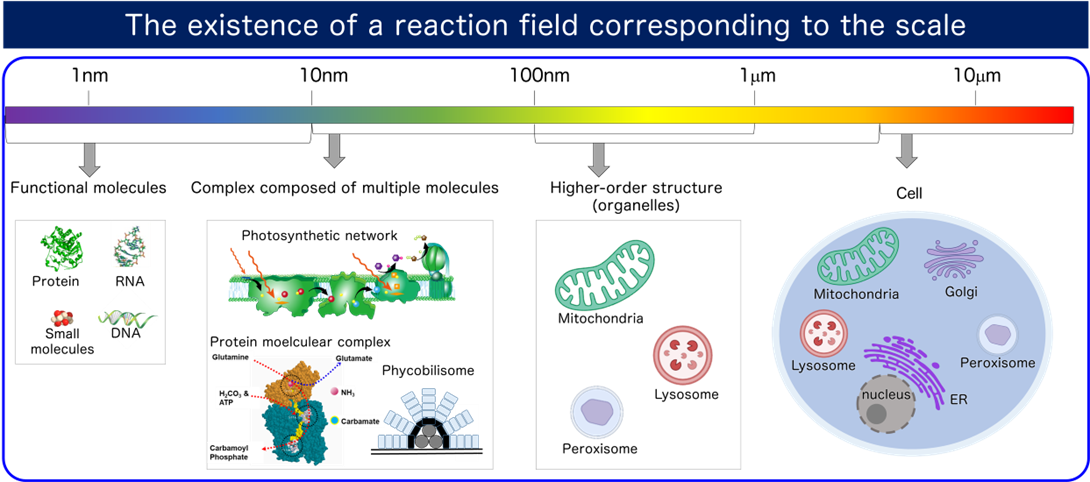
The energy utilization system of living organisms is constituted by countless chemical reactions (metabolic reactions) occurring in parallel within the limited, mild environment of water at room temperature and atmospheric pressure. Enzymes, the biological catalysts within the body, are responsible for each of these individual chemical reactions. Their fundamental role is supported by their ability to catalyze complex chemical reactions under mild conditions and their high selectivity.Furthermore, these chemical reactions are dynamically controlled and intricately interconnected through distinct “reaction sites” corresponding to different scales: from intramolecular (Å-nm scale) and intermolecular complexes (supramolecular structures) and higher-order assemblies (organelles) (nm-μm scale), to cells (μm scale), and individuals (mm-m scale).In other words, the excellence of biological energy utilization systems stems from the existence of reaction fields based on different strategies tailored to each scale.
〇Research policy
Our research group aims to realize clean, highly efficient energy utilization systems by harnessing chemical energy. We do this by emulating the outstanding energy utilization systems of these organisms and controlling biochemical reactions within organisms through scale-specific strategies. Currently, we are focusing on metabolic reactions that fix carbon dioxide within organisms. By engineering these reactions, we are advancing research aimed at synthesizing high-value-added useful substances.(*Research results will be updated sequentially as they become available for public release)